
West Africa Overland
West Africa Overland
A Journey Beyond Borders
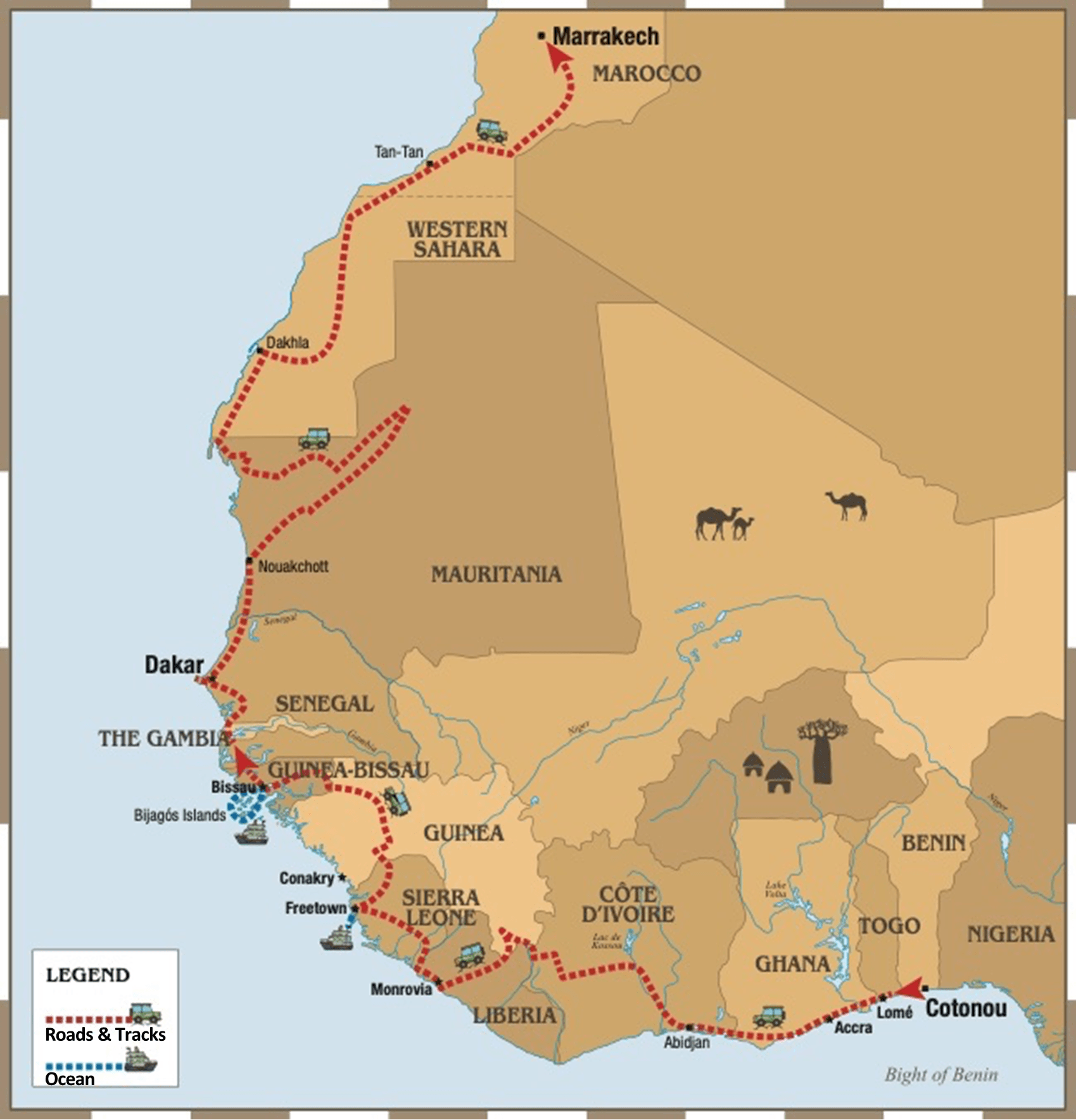
Embark on the ultimate West Africa Overland adventure, a 56-day expedition that spans deserts, coastlines, and vibrant cultures. Starting in Marrakech, this journey takes you through Morocco’s High Atlas mountains and across the golden dunes of the Sahara. Explore ancient caravan routes, hidden oases, and prehistoric rock art before reaching the Atlantic coast.
As you travel south, experience Morocco’s dramatic estuaries and lagoons, then cross into Mauritania to discover Chinguetti and Ouadane, historic towns that echo centuries of Saharan heritage. Continue along Senegal’s pristine beaches and colonial Saint-Louis, where colourful markets and lively streets showcase the region’s charm.
Your West Africa Overland route unfolds through The Gambia’s lush wetlands and Senegal’s Casamance, a land of rivers and mangroves. In Guinea-Bissau, navigate the Bijagos Archipelago, a sanctuary of biodiversity and cultural depth. Further inland, Guinea’s Fouta Djallon highlands reveal breathtaking waterfalls, mountain vistas, and bustling markets.
The adventure continues through Sierra Leone, Liberia, the Ivory Coast, Ghana, Togo, and Benin, each offering unique encounters. Explore UNESCO-listed forts, vibrant music scenes, and sacred ceremonies. Wander through colonial towns, relax on palm-fringed beaches, and immerse yourself in the rhythms of local life. From the historic streets of Accra to the cosmopolitan energy of Abidjan, every stop adds a new chapter to your story.
Throughout this West Africa Overland expedition, enjoy comfortable accommodations, authentic cuisine, and expert guidance. This is more than a tour. This is a cultural odyssey across diverse landscapes and histories, designed for travellers seeking depth, discovery, and connection. From desert silence to ocean breezes, from ancient traditions to modern cities, the West Africa Overland expedition celebrates the richness of West Africa.
Day 1 – Marrakech (Morocco)
On arrival at the airport, you will need to make your way to the hotel for the arrival meeting at 8pm.
Overnight at the Novotel Kenzi Rose Hotel or similar
Day 2 - High Atlas (Morocco)
We will leave the main road to discover the least frequented Berber villages in the High Atlas Range and join the gem diggers. With their help, you may find your own gems. The itinerary crosses the Tizi n'Tichka pass on the southern side of the Atlas. Ait Benhaddou is along the ancient caravan route linking Marrakech with the Sahara. Over the years, many famous films have been filmed in this Ksar, such as Lawrence of Arabia, Sodom and Gomorrah, Oedipus Rex, The Sheltering Sky, The Jewels of the Nile, Jesus of Nazareth, Alexander, Gladiator, and more. Arrival in Ouarzazate, a large oasis at the edge of the desert. Dinner and overnight stay in an international hotel inspired by traditional adobe architecture with comfort, Wi-Fi and air-conditioning or similar
Day 3 - Ouadi Draa & Rock Art (Morocco)
The tour now follows the first part of the Ouadi (river) Draa. This important river and its floods have created a long strip of continuous palm grove, a long, unique oasis with millions of date palm trees. Visit an archaeological site with hundreds of rock art images depicting hunters, warriors, horse raiders and wildlife. This is a silent witness to people living in these regions thousands of years ago, before the desertification. Lunch in a restaurant at the charming oasis of Zagora, and your itinerary will continue along the Draa valley to Mhamid. Mhamid is the last permanent outpost before the total desert. Dinner and an overnight stay at the comfortable hotel Pacha in the oasis, air-conditioned self-contained bungalows, Wi-Fi or similar.
Day 4 - Dunes, Fossils and Antelopes (Morocco)
From Mhamid, your Sahara adventure starts with 4x4 off-road driving through the high dune region of the Erg Chegaga. Here, with a bit of luck, you may encounter some rare and endangered white addax antelopes... The addax is a critically endangered desert antelope found in isolated regions of the Sahara. After, you will reach the dry Salt Lake of Iriki and a site where you may be able to find your own fossils. After an intense day driving in total off-road, you will reach the picturesque oasis of Foum Zguid.
Dinner and overnight stay at Bab Rimal, the best hotel in the region. Air-conditioned, self-contained bungalows, swimming pool, and Wi-Fi or similar.
Day 5 - The Oasis Trail (Morocco)
On the road again, as you cross a region of spectacular scenery with rocky mountains and large oases. Walk through the oasis to discover this miracle amid an arid environment. Lunch in a local restaurant before an evening arrival at the small oasis of Icht at the best hotel in the region: Borji Biramane, air-conditioned self-contained bungalows, swimming pool, and Wi-Fi or similar
Day 6 - Caravan Terminals (Morocco)
In the rarely visited region of Assa, you will discover the same ancient Arab-Berber stone architecture that you will see again nearly a thousand miles away, on the southern edge of the Sahara, in the oases of Chinguetti and Ouadane, in Mauritania. The small town of Guelmim is an ancient caravan terminal. Here you will search for the remains of the ancient Trans-Saharan trade. From this point onward, the itinerary will follow the coast and the route of the paleo-arctic birds that migrate from Northern Europe and Russia to overwinter in Africa. The migratory birds' route will serve as a reference for your itinerary as far as the Bijagos archipelago in Guinea-Bissau. A spectacular ghost military fort still “guards” the former borders between the French protectorate of Morocco and the Spanish Sahara.
Scouting the fort will make you feel like you are on the set of an old French Foreign Legion movie. Evening arrival at the charming and comfortable Ksar Tafnidilt hotel, built using local material in a beautiful Saharan architecture. The hotel is managed by our friends Magali, a French lady. Magali is a desert expert; she won the “Rally des Gazelle,” the most challenging off-road competition reserved for female teams. Ksar Tafnidilt is a meeting point for passionate Saharan travellers who exchange the latest news on track conditions, border formalities and more. The hotel will be our base for two nights. Self-contained air-conditioned rooms.
Day 7 - Estuaries and Desert (Morocco)
Once you leave Tafnidit, you will cross a steep range of dunes to reach the Dra estuary region, visited by only a few brave travellers who dare to find their way on the sandy tracks between the cliffs and the Atlantic Ocean. Here, you will discover temporary settlements of fishermen, ghost colonial military posts, dunes and camels in a virgin landscape. If you're lucky with the tide, you will drive for miles on a wild beach where the high dunes meet the ocean. You will leave the coastline, following a riverbed (Ouadi) in a large canyon: the only possible path between the high dunes, cliffs and ocean. Evening return to our comfortable base, the Ksar Tafnidilt hotel.
Day 8 - Dunes and Lagoons (Morocco)
From Tan-Tan, the road follows an exciting route through a crag on the edge between the Sahara and the ocean. The Naila salt lagoon, separated from the ocean by rows of dunes and bordered by an estuary, is the largest Salt Lake in Morocco (100 square km). A protected area of outstanding natural beauty, it is an important resting point on the birds migratory journey; it can host up to 20,000 individual species, such as flamingos, cormorants, gulls, herons and more. You will board local fishing boats to explore the emerald water enclosed in a wide frame of yellow dunes and brown escarpments in an astonishingly beautiful landscape.
It is a late afternoon arrival at the tiny town of Tarfaya on the Juby Cape, less than 100 km away from the Canary Islands. Tarfaya was a former “Aeropostale” base that pioneered airmail from Europe to Africa and Latin America. There is a fascinating museum and the remains of colonial Spanish architecture.
Overnight at the Hotel Casamar, self-contained, air-conditioned rooms, and Wi-Fi or similar
Days 9 & 10 – The Western Sahara (Morocco)
In Laayoune, you will meet the local guide, a nomad from a Sahrawi community who will lead you through a three day off-road expedition crossing the Western Sahara. The former Spanish Sahara colony has been the site of a long war between the Polisario Armed Front and the Moroccan army. Nowadays, it is part of Morocco. Since the second half of the seventies, due to this long “sand war,” the region has been off-limits to travellers. No peace treaty has been signed, but it's been decades since any fighting has occurred in the strip you cross.
We are proud to be one of the first to bring intrepid travellers to the vast, sandy regions of Saguia El Hamra and Tiris Zemmour, culminating in the spectacular Rio de Oro. On this Saharan expedition, you will cross large dunes to discover wells frequented by long lines of camels belonging to the legendary Reguibat nomads.
On this part of the expedition, you will be camping under the stars. The mobile camp will be comfortable: Bedouin-style large tents, carpets, mattresses. Chairs, tables and a choice among soft drinks, beer and wine for dinner. A portable toilet is available. In the unfortunate case of a sandstorm, a restaurant tent will be set up.
Day 11 - From the Desert to the Ocean (Morocco)
This morning, continue your Trans-Saharan expedition through a region of dunes, wells and nomadic camps. In the afternoon, a road will bring you to the ocean.
Arrival at Hotel Buena Vista, facing the ocean, it will be our base for two nights.
Day 12 - Rio de Oro (Morocco)
The astonishing beauty of the Dakhla Peninsula landscape makes it a unique place. The Rio de Oro is a 25-mile-long sea loch between cliffs and dunes. Pastel colours paint the scenery: the blue ocean, yellow sand, emerald seaweed fields and dark rocks. Experience a unique event as during high tide, the sea will flood the desert, and white dunes and rock hills will become temporary islands. The small town of Dakhla was founded by Spanish navigators in 1502 as “Villa Cisneros.” Visit the colourful fishing harbour and have lunch in an oyster farm. Drive along the shore where the waves lap the sand dunes. Dinner in a typical restaurant. Overnight return to our four-star hotel.
Day 13 – Border Lines in the Sands (Morocco & Mauritania)
You follow the only open road going south and come across a signboard that indicates that you are “on” the Tropic of Cancer. At Guerguerat military post, you will cross the southern border post of Morocco and then travel a few miles into no-man's land. The boundary is a theoretical line in the desert that “divides the sand from the sand,” and on the other side is the military post of Mauritania. It is an evening arrival in Nouadhibou.
Overnight at the comfortable El Medina, four-star hotel, or similar.
Days 14 & 15 – Adrar Massif (Mauritania)
A day of driving between road and trail will take you to the mining town of Akjoujt. After Akjoujt, it is off-road through high dunes. To cross this long stretch of dunes, the team will reduce tyre pressure, and GPS, maps, and a compass will assist with navigation in an untouched geological region. Erg Amatlich is one of the most beautiful dune basins in Mauritania, and the Sahara can make a traveller feel like the first person on a planet. You will discover traces of a thousand-year-old human presence, including stone tools and pottery shards. You will find nomadic settlements, and these human encounters, after the deep silence of the desert, can be intense. You will explore the scenic landscape of the Adrar massif with its valleys, high mountains, yellow dunes, and peaks of dark and red rock. Enjoy remote oasis and tiny adobe villages, and after a long and intense day, arrive in Chinguetti, where you will spend two days visiting the region.
Day 14 - Dinner and overnight stay at the Sahara hotel, a recent hotel with air-conditioned self-contained rooms.
Day 15 - Dinner and overnight stay at La Gueila, a cosy guest house built in the traditional Mauritanian style, which will be our base for three nights (or a private, comfortable residence). air-conditioned rooms, hot water, wi-fi. Fine restaurant, local specialities with a French touch or similar.
Day 16 – Chinguetti (Mauritania)
Spend the day discovering the unique atmosphere of Chinguetti considered the jewel of the Mauritanian Oasis. This stone citadel dates to the 13th century and is a cross-point of different trans-Saharan routes linking the Mediterranean coasts to Black Africa. Discover the atmosphere of the old stone town, its architecture, and some ancient medieval manuscript collections. The central Mosque and the stone minaret in Chinguetti are believed to be the second-oldest still operating in the Muslim world.
Return to our cosy guest house.
Day 17 – Ouadane (Mauritania)
You will drive to Ouadane on an off-road itinerary that follows a Ouadi (dry creek), discovering tiny oases hidden in the high dunes. Experience Ouadane, the remotest oasis in Mauritania, an outpost in the emptiness of the desert. Ouadane was founded in 1147, while most of it fell into ruin, some of its stone houses, perched on a rocky hill, are inhabited. Back in the day, this town was an important trading point on the caravan route. Trading was so good that, in 1487, the Portuguese built a fortified castle in the region.
Return to our comfortable base in Chinguetti. Dinner and overnight stay at “La Gueila” or similar.
Day 18 - Green Oasis (Mauritania)
The landscape will never cease to amaze. Leaving the main track, you will reach a region of spectacular mountains, gorges and canyons. Infinite space dominated by the ochre of the earth and the blue sky. At the horizon, the ruins of Fort Saganne, and the Agrour site, located at the top of the Amogjar pass, hides prehistoric rock art. After a short visit to the Atar market, you will reach Terjit, one of Mauritania's lushest oases. Walk through a dense palm grove protected by a gorge and follow a tiny stream, where you will discover a vast rock shelter where spring water flows. An unexpected atmosphere disconnected from time and from the harshness of the desert. Dinner and overnight stay at Hotel Sahara or a similar hotel.
Day 19 - Noukchott (Mauritania)
Today you will arrive in Nouakchott, the capital of the country. As a resume of Mauritanian history and culture, you will visit the fascinating National Museum, which displays archaeology, artefacts, costumes and textiles from prehistory to the present day. View unique pictures taken during excavations at Aoudaghost, the northern trading town and well-preserved site of the legendary Ghana Empire. Ghana was the oldest Empire and Kingdom known in the region.
Founded in the 6th century, the empire was located in the southeastern part of Mauritania. At that time, the caravans transporting gold to North Africa departed from Aoudaghost and passed through Ouadane and Assa, which you discovered during your Sahara crossing. Lunch in a restaurant managed by women from the Ivory Coast, who will introduce us to the tasty cuisine of West Africa. Hundreds of colourful pirogues lining he beach at Nouakchott fishing harbour are a great photo opportunity. Mauritania processes more than 1,800,000 tons of fish each year. Dinner and overnight at the international standard 4-star hotel Azalai, comfortable air-conditioned rooms with private facilities.
Day 20 - Djoudj Ornithological Sanctuary (Mauritania & Senegal)
Early morning departure in the direction of Senegal. The natural border between Mauritania and Senegal is the Senegal River, which marks the transition from desert to savannah. You will cross the river on a mobile bridge and move into a unique wetland between the Sahara and the Sahel. The Djoudj National Park, a World Heritage Site, is a green oasis spanning hundreds of miles of partially flooded land. This is the habitat and nesting site of over a million migratory and sedentary birds. Surrounded by an arid landscape, more than 400 species live temporarily in this unique bird sanctuary. You will enjoy a boat excursion to visit an island with an astonishing concentration of pelicans.
Arrival in the evening in Saint Louis. Dinner and overnight stay at “Hotel de la Poste”, a historical hotel built in 1850, that was the base of the “Aeropostale” (airmail pioneer operation) pilots. Totally restored, it has conserved one of the best “old colonial atmospheres” in town.
Day 21 - Saint Louis (Senegal)
In the morning, visit Saint Louis, the first capital of the French colonies in West Africa, AOF (Afrique Occidental Francais). It is a charming old town, situated on two twin islands, the colonial and the local, located between the Senegal River and the ocean. The best way to roam the narrow streets of Saint Louis is on board a kalash, as the locals do. Artisan shops, art galleries, libraries with ancient and modern books and an interesting photographic museum are among the highlights of this charming old capital.
Day 22 – Fishing Villages and Holy Men (Senegal)
An unforgettable day as you travel almost 100 miles off-road in 4x4 vehicles along the beach. Discover the largest fishing village in Senegal, where more than 4,500 wooden pirogues come to the shore with the catch of the day. You will leave the vehicles for a less intrusive and fun local transport, a donkey chariot, an ideal way to approach the fishermen selling their catch to the women, the queens of the market.
You will familiarise yourself with the artisans carving the large pirogues, the painters decorating them with bright colours. End the visit with an interesting encounter with a "Marabut" (local holy man) who will receive you in his large mansion. Specialising in blessings intended to protect pirogues and fishermen, the Marabut will introduce you to the ancient techniques of geomancy and divination.
Continue to Lac Retba, also known as Lac Rose. It is a shallow saltwater lake surrounded by dunes. Dinner and overnight stay at the Trarza Hotel, with air-conditioned, self-contained rooms.
Day 23 - Dakar & Gorée Island (Senegal)
Senegal's capital became an important centre of political, artistic, and intellectual “renouveau” during the period of independence, and it remains the liveliest metropolis in French-speaking West Africa. Visit the “Musée des Civilisations Noires”, including significant collections of tribal art, textiles, and contemporary local artists. The “Plateau” district, the Presidential Palace, a typical market, and the fully restored Dakar-Bamako railway station, an excellent example of colonial architecture.
Take the ferry to Gorée Island. The best time to enjoy Gorée's atmosphere is at sunset, when most tourists have left. Slaves waiting to be shipped to the Americas were crammed onto Gorée Island and the island still bears witness to those times. Today, the breezy climate, history and ancient architecture, along with fine restaurants and boutiques, make Gorée an attractive and trendy destination for local and foreign visitors. Dinner in a typical restaurant and overnight stay at “Maison Municipal” or similar. A comfortable guesthouse in an ancient, restored building.
Days 24 – The Salt Pans of Kaolak (Senegal)
You head to Kaolack town, in a region of salt pans. Lunch in a local restaurant. Kaolack, situated on the Saloum River, is an important port for exporting peanuts and salt from Senegal and neighbouring countries. Dinner and overnight at the comfortable air-conditioned bungalows of Relais de Kaolak or Kabacoto Safari Lodge, or similar.
Day 25 - Archaeology and Contemporaneity – (Senegal & Gambia)
Early departure heading to the region between the north bank of the Gambia River and Senegal, which has hosted one of the largest megalithic civilisations on earth, Sine Ngayene. You cross the border into The Gambia, a tiny English-speaking country bordered by Senegal, and take a very local ferry across the large Gambia River estuary to reach Banjul, the country's capital. Visit the national museum. Optional: evening live music in town. Dinner and overnight stay at the Atlantic Hotel or a similar hotel.
Day 26 - Gambian Birds – (Gambia & Senegal)
This morning, enjoy a brief but intense bird-watching experience led by an expert as you travel through different natural environments, including wetlands and savannahs. Arrive at the Casamance border, the southern region of Senegal. You will notice the natural environment will gradually change from savannah to forest.
Late afternoon arrival in Ziguinchor, a charming small town with interesting colonial architecture and a large market. You will spend two nights at the comfortable Kadiandoumange hotel: traditional colonial-style buildings and gardens overlooking the large Casamance River. Self-contained air-conditioned rooms that combine modern comfort with stylish African decor, and a gourmet restaurant on a riverside terrace. Or similar.
Day 27 - Kings and Masks – (Senegal)
The road will pass through a spectacular landscape of lagoons, mangroves and small islands created by the Casamance River estuary. In a remote village, you will be received by the Monarch of one of the oldest Diola (Jula) Kingdoms. In ancient African traditions, the king is also the High Priest, concentrating political and mystical powers in his person. After the traditional libation offering at the edge of the sacred forest, His Majesty will be happy to answer our questions about the history of his people, the rules of a traditional chief, and the complex taboos and mystical meanings of kingship in Diola culture.
In the afternoon, you will join the ritual dances of the sacred masks of the Diola people. The masks belong to a secret society, and the identity of the dancers is not revealed. The mask is said to be animated by spirits and drums, dances and a colourful crowd will enliven the small village under the shade of large kapok trees.
Return to our base in Ziguinchor: Hotel Kadiandoumange. Or similar.
Day 28 - Between the Water and the Land – (Senegal & Guinea-Bissau)
After crossing the border with Guinea-Bissau (formerly Portuguese Guinea), the road will take you south to a unique ecosystem where Bolon (sea arms) penetrate the land for more than 100 miles, creating a large temporary flooding area. The borders between salt water, land and fresh water are uncertain and change with the tides. 23% of Guinea-Bissau territory is under water during the high tide and emerges during the low tide. Arrival in Bissau. Dinner and overnight stay at Azalai-Dunia Hotel, international four-star hotel. Or similar
Day 29 - Bijagos Archipelago – (Guinea-Bissau)
Experience a three-day tour using a speedboat to discover the Bijagos Archipelago, its fascinating nature and isolated communities. The Archipelago, composed of 88 islands and islets, is located at an average of 40 miles from the coastline. Bolama was the former capital of Portuguese Guinea from 1871 to 1941, when it was moved to Bissau. When the Portuguese left, native people began moving into this town. The town is now falling apart, partly invaded by tropical vegetation.
In the shade of the columns of the former governor's palace, goats graze peacefully, and although inhabited, this town enjoys the fairy-tale atmosphere of a ghost town. Dinner and overnight stay at Ponta Anchaca Resort, four stars, international standard, in comfortable air-conditioned wooden bungalows, hidden in the vegetation and facing the ocean. Restaurant on stilts with refined French and tropical cuisine. This fine lodge will be your base for two nights.
Day 30 - Vaca Bruto Dancing Ceremony – (Guinea-Bissau)
Take a short trip to discover Bubaque Island, the “capital” of the Bijagos Archipelago and explore its market. Due to the remoteness and the locals' deep-rootedness in their traditions, the Bijagos people have been little influenced by the outside world. Initiation rites and secret ceremonies characterise life in the villages. In some villages, the young men must go through a seven-year initiation rite, living in a “convent” with no contact with women.
In the Bijagos Archipelago, life is still ruled by the “cycle of seasons”. During the long dry season, the major ceremonies take place. Vaca Bruto (wild bull) is the most spectacular, and dancers convey a realistic presence by bowing and facing the ground. The mask’s eyes are made of frosted glass, real horns, leather ears and a rope through the nostrils, providing the mask with a real aspect of an untamed animal, which represents a man in full possession of his physical strength but still with an immature behaviour, as he has not yet undergone the final initiations. All the villagers attend this fascinating ceremony. Return to our comfortable base at Ponta Anchaca Resort.
Day 31 - Islander Life – (Guinea-Bissau)
This morning, relax at Ponta Anchaca's wild beaches and swimming pool, or go on a walking excursion on the island. In the afternoon, you will travel to Bissau.
On request (not included), Early morning departure for an excursion to Orango Island in search of a residual fauna of Hippos that has acclimatised to life on islands. Mainly, they live in fresh-water swamps, and sometimes they swim in the ocean. A local guide will lead and an encounter with the hippos is not always granted.
On your arrival in Bissau a vehicle will be waiting for a brief city tour. Bissau is a tiny but intriguing capital, with interesting old Portuguese architecture and a huge fort, a reminder of the slave trade era. Overnight hotel Azalai-Dunia, four stars, international standard.
Day 32 - The African Troubadours – (Guinea-Bissau)
It is an early departure today, and after lunch, you leave the main road for a small village in the Malinké region. The Malinké are the descendants of the ancient Mali Empire and are widespread in the current territories of Mali, Guinea Conakry, the Ivory Coast, Senegal, and Guinea-Bissau. Griots are a group of musician-narrators dating back to the 13th-century Mali Empire.
The village you visit is known for griot families who have been passing on these traditions for generations since the days of the Empire. Well-known for their skills in producing musical instruments, they will perform a concert. Later you will arrive in Gabu.
Dinner and overnight stay at the Hotel Karsa, air-conditioned self-contained rooms.
Day 33 - Fouta Djalon (Guinea-Bissau & Guinea)
It is a very early departure for a long day of driving. At a remote border, you will cross into Guinea (Guinea-Conakry, former French Guinea), a region with vast empty spaces, spectacular mountains covered with wooded savannah, tropical dry forests, and isolated Fulla (Peul) settlements on the Fouta Djalon massif. Considered the most spectacular area of Guinea, thanks to the mountains, highlands, savannah and deep valleys, the Fouta Djalon is the “water reservoir” of West Africa.
As a matter of fact, 3 rivers that give name to 4 nations: Niger, Nigeria, Senegal and The Gambia, have their offspring in Guinea. The Fulla inhabits this territory, famous for their beauty cult and their skills as the main stockbreeders of Zebu cows in West Africa. Evening arrival to Labe and overnight stay at the basic but clean Hotel Tata, self-contained bungalows with A/C.
Day 34 - Wild Highlands – (Guinea)
A relaxed morning departure as the first day in the Fouta is dedicated to discovering its nature and the architecture of this unique mountain and highlands. You will start by visiting the Labe market, the region's busiest. Leaving Labe, you will discover an environment where mountains meet savannah and a deep valley with forest.
Have a picnic lunch surrounded by the jungle, facing a complex of waterfalls that crash over three separate falls. Arrival in Dalaba at 3,900 Ft (1.200 m.) altitude, a small and pleasant town. The “casa a palabra” (the house of word) with fine adobe bas-relief is in a pure Fulla architectural style. Here, the chiefs used to meet with the colonial administration. Visit the villa built by the colonial governor and later used by the first president of independent Guinea. You will spend two nights at the same hotel in Dalaba.
Dinner and overnight stay at Tinka hotel, the best available in the region. Air-conditioned self-contained rooms, swimming pool.
Day 35 - The Council of the Elders – (Guinea)
Driving on a track through valleys and mountains, you will come to a remote village. After being introduced by our connections to the elders and presenting traditional gifts of cola nuts, you will have the privilege of being received by chiefs and dignitaries sitting in council. In a very large clay round hut with a decorated grass roof, dressed in traditional costumes, the descendant of the oldest Fulla Kingdom will tell you the history of their people and agree to answer your questions about the origins of their communities and the traditional rules still practised.
Returning to Dalaba, you will visit the Jardin Chevalier, created during colonial times by Auguste Chevalier, a French botanist, to experiment with how foreign plants, predominantly Asian and European, could be adapted to the special climate of Fouta Djalon and from here to the African colonies.
Dinner and overnight stay at Tinka hotel.
Day 36 - Baga Nimba – (Guinea)
Your itinerary takes you through valleys and mountains and brings you to Kindia for a late lunch. Kindia is a pleasant trading town between Fouta Djalon, the coastal regions, and the western forests. This evening, dinner will be a special tasting of different specialities of Guinean gastronomy. Then, illuminated by the glare of the fire, called by the intense rhythm of the drums, will appear and dance the local mask from the sacred forest. The most spectacular is the Baga Nimba, considered one of the country's symbols.
Overnight at Hotel Masabi or Moringa, air-conditioned, self-contained rooms or bungalows, or similar (no twin rooms available).
Day 37 – Freetown (Guinea & Sierra Leone)
You have an early departure, and the road joins the border of Sierra Leone. Approximately late afternoon, you will arrive in Freetown, the capital of the country. Dinner and overnight stay in Freetown, at the comfortable Swiss Hotel, 4 stars, international standard
Day 38 – The Mountains of Lions (Sierra Leone)
Freetown is a busy, colourful, and intriguing large (long) town between a rocky hill range and the Atlantic coast. You will explore the city, including its colonial architecture, the remains of the Cotton Tree, the National Museum with a fascinating collection of tribal masks, the Palace of Justice, St. George’s Cathedral, and the unique Sierra Leone Peace Museum. This retraces the history of the ten-year-long civil war that devastated the country. Drive along the coast at the slopes of the Freetown peninsula mountains with only the yellow of the beaches dividing the green of the forest from the blue of the ocean.
The country has been named after these mountains, the Sierras (mountains) of the lion. River number two is considered one of the nicest beaches in West Africa. Arrival at the village of Kent. A local boat will bring us to Banana Island.
Dinner and overnight stay at the cozy Bafa Lodge. Fixed tents hidden in the forest facing the ocean. Sanitary central block with showers and services. Fine cuisine based on the catch of the day (other meals available, ask in advance).
Day 39 - Banana Island – (Sierra Leone)
This morning, explore the island to discover a pristine paradise, including mountains hiding primary forests, a Kriol village with a remote Caribbean feel, and small beaches. Return for lunch. Afternoon drive on a tarred road to Bo, the second town of the country, where you will spend two nights.
Day 40 - Diamonds and Female Masks – (Sierra Leone)
Diamond seeking is as addictive as gambling. The possibility of finding a fortune can become true, just for a few of the luckiest. Diamonds have played an important role in the country's recent troubled history. The quantity and quality of stones still to be found are important.
You will reach a village, and after asking the chief for permission, some villagers will take you to the site where you can meet the diamond seekers. A local person explains the techniques of artisanal mining and “sand washing” to you. In town, you can visit a Diamond Shop, where rough diamonds and digging equipment are traded.
In most parts of Africa, masks are a male prerogative; however, among the Mende people and neighbouring populations, the Bundo masks are a female domain. You will reach a village to attend the exit of the masks, an event that calls a colourful crowd.
Dinner and overnight return at the comfortable Bo Inn Hotel or Dohas hotel, self-contained rooms with A/C, or similar.
Day 41 - Pepper Coast – (Sierra Leone & Liberia)
A spectacular road takes you through the forest to the Mano River and to the border with Liberia. The border is marked by a bridge over the river in the forest that divides the two countries. After the police and customs formalities, you will enter Liberia. In ancient times, the coast of Liberia was known as the Pepper Coast to European navigators, who traded a rare spice, the Melegueta Pepper, also called Grain of Paradise. Arrive in Monrovia.
Dinner and overnight stay at the comfortable and friendly Cape Hotel, four stars, international standard, at Mamba Point, the best quarter of Monrovia or similar.
Day 42 - The Land of Freemen – (Liberia)
Liberia is the only African country which has never been either a colony or a protectorate. Liberia was founded by Kreyols (Krio), freed slaves who came back to Africa from the USA, and for this reason was named “Liberia”. Kreyols make up 5% of the population and are the leading actors in the economy and politics. They are considered the creators of the Nation and of the modern economy. 80% of the population speaks the local Kreyol language, a sort of American English Pidgin.
Your ocean-view hotel is the starting point for an interesting walking visit to the town. Freemasonry had a significant impact on the history of Liberia and Krio culture, and you will visit the Grand Masonic Temple and, if lucky, meet with the Grand Master. A symbol of Monrovia is what is left of the Ducor Palace Hotel, inaugurated in 1960, which was one of the first five-star hotels in Africa. Located on a rocky hill at the highest point in Monrovia, it dominates the entire town and the gulf. The hotel hosted social events and parties for African elites during the vibrant time of independence. In the large swimming pool facing the ocean, Idi Amin used to swim while his friend, Miriam Makeba, sang.
After the civil war, the building was looted several times. The hotel is now abandoned and closed, but seeking the proper permission, you may be able to visit it. The building of the National Museum is itself a display of Krio traditional architecture, within which you will discover a large collection of ancient masks and ritual objects. The visit includes a photographic show about the civil war, which took place between 1989 and 2003. Old colonial buildings and stone Krio churches will also be part of this intriguing town visit. Lunch and departure for Ganta.
Dinner and overnight stay at Alvino Hotel, air-conditioned self-contained rooms, or similar.
Day 43 - Liana Bridges – (Liberia & Ivory Coast)
You will have an early departure for the Ivory Coast. After formalities, a road through lush vegetation will take you to a remote village, and a short walk will lead to a spectacular liana bridge crossing a large river in the jungle. Liana bridges are a masterpiece of a genuine tribal technology. They are built exclusively with vegetal materials, as wood and lianas, without the use of nails, ropes or other materials foreign to the forest.
Only the initiated can harvest the liana and it is believed that a powerful spirit will build the bridge in one night. Neither women nor non-initiates are allowed in the forest during the preparation of a new bridge, to ensure the secrecy of this 'magic technology'. You have an evening arrival in the small town of Man, the capital of this forest region. Spend two nights at a comfortable hotel in Man. Dinner and overnight stay at Hotel Amoitrin, air-conditioned self-contained rooms, swimming pool or similar.
Day 44 - Dan Masks (Ivory Coast)
The small town of Man is the capital of the We, Dan, and Guéré ethnic groups, known for their masks, which are considered among the masterpieces of African art. You will have a full day discovering the Man region. In a nearby village, encouraged by the incessant rhythm of tam-tams, masks will emerge from the forest.
According to the cosmogony of the Dan people, there is a supreme god that creates the world and communicates with humans only through its intermediaries, the masks. During the masks’ dance, the distance between the humans and the spirits disappears, the cosmic and the social orders are restored, and gratitude is expressed to the gods and the ancestors. Dan Masks are among the finest African masks, known for their balanced shapes.
Man’s market is an important market where villagers from the region and neighbouring countries come. It will be possible to find a large choice of handicrafts and, with a bit of luck, authentic masks and traditional objects.
Return to the Hotel Cascades or Amoitrin or similar.
Day 45 - Magical Traditions – (Ivory Coast)
This is a full day dedicated to experiencing the vibrant tribal culture and magical traditions of the country. 4X4 vehicles will be needed to reach a remote region where the arrival of foreigners is rare. The track across rudimentary log bridges will lead you to an isolated settlement inhabited by the Gueré, whose masks are recognised and collected for their powerful expressive power.
The masks will dance through the village. If lucky you will witness the rare “Jugglers” performances. Girls initiatory juggling is an ancient tradition, now vanishing. The initiated girls, their faces painted with white kaolin, will perform a spectacular acrobatic dance, "flying" from one dancer to another. Return to the main road and reach the town of Daloa in the evening.
Dinner and overnight stay at Hotel La Grace***, self-contained air-conditioned rooms, or similar (no twin rooms available).
Day 46 – Capitals and Coffee – (Ivory Coast)
Continue your journey across coffee and cocoa plantations, dotted only by small villages. Ivory Coast is the world’s leading cocoa producer, with Ghana second, and together they account for more than half of the world's cocoa production.
In a village of the Guro communities, we attend the Zaouli dancing masks. The Zaouli mask was probably inspired by a girl named "Djela Lou Zaouli"; however, the stories on the origins of the mask are varied, and each mask can have its own symbolic history. The uniqueness of the Zaouli dance is the delicate and sophisticated movement of the legs and feet. In the afternoon, you will reach Yamoussoukro, the country’s formal capital. Here, the Ivorian dream of the 1970s and 1980s has come true: a country that, despite its lack of major natural resources, has built the most flourishing economy of French-speaking West Africa, rivalling in architectural style and size the European capitals. You will visit the Basilica of the Virgin of Peace, inspired by St Peter’s in Rome.
In the city, you will see wide boulevards where the few cars try to avoid big potholes, Zebus and chickens, huge government buildings, the lofty hotels up to 14 floors high and even an artificial lake inhabited by crocodiles! Despite the title of capital city, the ministries, embassies, and the presidency of the republic itself remained in Abidjan. Dinner and overnight stay at the comfortable Royal Hotel, swimming pool, air-conditioned self-contained rooms, or similar.
Day 47 - Abidjan, Skyscrapers and Lagoons – (Ivory Coast)
You drive on the only highway in the country to reach Abidjan in the late morning. Beyond the lagoon, the “plateau” (the City District) is growing very fast, while most African cities grow horizontally, Abidjan grows vertically. Not much land is available, and the little available must be continually recovered from the waters of the Ebrié Lagoon.
The modern City District is defined to the west by the harbour and its endless queues of people waiting for a public boat, and to the east by the silhouette of Saints Peter & Paul Cathedral, built in a futuristic spirit by Italian architect Aldo Spirito in 1980. In the Youpugon district, we will meet the Fanico people who wash clothes in the river and dry them on the surrounding lawns. Hundreds of colourful fabrics spread out on the grass create a giant patchwork. The chaotic traffic is a result of this country's rapid economic development.
Dinner and overnight stay at the comfortable and recent Hotel Azalai, four stars, international standard.
Day 48 - Grand Bassam – (Ivory Coast)
It is a short drive to Grand Bassam, an old town built on a sand bank between the lagoon and the ocean. It was the first capital of the French Ivory Coast colony and is now a maritime leisure resort for the Abidjanese. Thanks to its calm avenues shaded by tall trees, large bougainvillaea and well-preserved colonial buildings, Grand Bassam has a magical atmosphere. The old post office is a jewel of colonial architecture.
The Costume Museum, in the former governor’s palace, with its large outer staircase is a true architectural gem and its unique collection of tribal costumes, masks, ornaments and ethnographic photographs gives an interesting perception of the country’s history and culture. In the late afternoon, we will reach the small town of Aboisso. Dinner at “La Place”, a vibrant square with many tables offering a choice of different street food and drinks.
Overnight at Hotel le Rochè, self-contained air-conditioned rooms, or similar.
Day 49 - Gold Coast – (Ivory Coast & Ghana)
You travel today from the Coast of Ivory to what was known as the Gold Coast. The abundance of gold led the first Portuguese navigators, who discovered this region in the 13th century, to call it the Gold Coast. The name was changed to Ghana upon independence in 1957. Once in Axim, we will visit St. Antonio fort, built by the Portuguese in 1515 on a bay near the estuary of the Ankobra River, in a region rich in gold dust.
The coast of Ghana is unique in all of Africa for the concentration of ancient castles and forts. Over three centuries, more than 80 fortifications were built by the Europeans to trade mainly gold, ivory and eventually slaves. Evening arrival at the Anomabu Beach resort, that will be your base for two nights. Air-conditioned self-contained bungalows near the ocean.
Day 50 – Elmina – (Ghana)
A full day dedicated to discovering ancient slave trade castles and animistic shrines.
After a stop at Cape Coast, you will visit Elmina Castle, the oldest and largest European building in Africa. “Sao Jorge da Mina” was erected by the Portuguese in 1482. At different times the castle has been used as a warehouse to trade originally gold, then ivory, and eventually slaves. The castle you visit today is the result of successive extension works and is recognized as a UNESCO World Heritage site. Facing the castle is the fishing harbour with hundreds of colourful and large fishing wooden canoes.
Dinner and overnight return to Anomabu Beach Resort bungalows, or similar.
Day 51 - Ashanti – (Ghana)
Late morning arrival in Kumasi, the historical and spiritual capital of the old Ashanti Kingdom. The Ashanti were one of the most powerful nations in Africa until the end of the 19th century, when the British annexed the Ashanti Kingdom to the Gold Coast colony. The honours still paid to the Asantehene (the King) testify to the Ashanti Kingdom's past splendour and power.
With more than three million inhabitants, Kumasi is a sprawling city with a fantastic central market, one of the largest in Africa. Every type of Ashanti craft (leather goods, pottery, Kente cloth) is found here, along with just about every kind of tropical fruit and vegetable.
The visit includes the Ashanti Cultural Centre, a rich collection of Ashanti artifacts housed in an interesting reproduction of an Ashanti ancient house. In the afternoon you will participate, if available, in an encounter with a traditional chief. Dinner and overnight at Miklin Hotel, air-conditioned self-contained rooms.
Day 52 - Accra – (Ghana)
You arrive in Accra in the early afternoon. The capital of Ghana has maintained its special identity despite the fast-paced development currently underway. You explore the James Town neighbourhoods, inhabited by the autochthonous Ga. Your tour ends with a visit to a workshop specialising in carving “fantasy coffins”. These special handcrafted coffins can take on any shape: fruits, animals, fishes, cars, and airplanes, the only limit being the imagination!
Dinner and overnight in Osu, the central and most vital district of Accra, at the comfortable La Villa Boutique Hotel. Self-contained air-conditioned rooms, or similar. Optional, Accra vibes: evening at one of the typical music bars in town if available.
Day 53 – Lome - (Ghana & Togo)
Morning departure to the Togo border. Lome is one of the rare capitals situated at the border of the country, the only African town which has been ruled successively by Germans, British and French and has attracted an important community of traders from different African countries and as far as from Brazil. These elements and influences have developed a unique lifestyle, cuisine and architecture.
Lome is still a meeting point for people, trade and cultures. You will visit the central market with the “Nana Benz”, women who control the market of the expensive “pagne” (colourful cloths) sold all over West Africa, the colonial buildings and the largest “fetish market” in the whole African continent. Here you can find an eclectic assortment of all the necessary ingredients for love potions, magical concoctions and Voodoo incantations. Lome is also an important trading centre for tribal art and artisanal crafts.
Overnight at Hotel Onomo, international standard, or similar.
Day 54 - Voodoo – (Togo & Benin)
Voodoo is the main religion in the coastal areas of Togo and Benin, and numerous adepts practise authentic ceremonies. The frenetic rhythm of drums and the chants of the initiates “call” the spirits, which will manifest by possessing some participants who fall into a deep trance, with eyes rolling back, grimaces, convulsions, and insensitivity to fire or pain. Sakpata, Heviosso, Mami Water are just some of the Voodoo divinities who can manifest.
Surrounded by the magic atmosphere of the ceremony, you will understand what local people mean when they say: “In your Churches you pray God; in our Voodoo shrine we become Gods!”. Trael to the border with Benin and arrive at the small town of Grand Popo.
Dinner and overnight stay at the charming Awale Plage hotel, oceanfront, self-contained and air-conditioned rooms or similar.
Day 55 – Ouidah – (Benin)
Between lagoons and ocean, you will discover the Zangbeto cult. The Zangbeto mask is very tall and covered in colourful straw. It represents wild, non-human spirits (the forces of nature that inhabited the Earth before humans). The mask wearers belong to a secret society and keep their identity hidden.
When the Zangbeto dance is performed, it is an event for the entire village. Its performance guarantees protection against evil spirits and witchcraft. The spinning movement of the mask symbolizes the spiritual purification of the village and Zangbeto also performs miracles to prove its powers.
Drive to Ouidah, a small town that was conquered by the Dahomey Kingdom during the 18th century and became a main slave shipping port. The ancient name of this coast was the Slave Coast. You start the visit following the “slave road” to the shore and “the door of no return,” where slaves were shipped to the Americas. Ouidah enjoys a rare Afro-Brazilian architecture, a unique mix of cultures in which the python temple faces the Catholic Cathedral. The locals' laid-back attitude blends with the thunder of the distant waves.
On foot, you will visit the Python Temple and the Portuguese Fort (currently closed for renovation), now a small but interesting museum on the history of Ouidah, the transatlantic slave trade, and the links the trade has created between West African coastal countries and Caribbean Voodoo culture.
Dinner and overnight stay at the comfortable Hotel Casa del Papa resort, or similar. Scenic ocean front bungalows, wild beaches, swimming pool. (Air-conditioned self-contained bungalows).
Day 56 – The Stilts Village – (Benin)
You will drive for miles on the fishermen's track between endless beaches, tall palm trees, grass huts and colourful pirogues. Leave your vehicles and cross Lake Nokwe on a motorised boat to reach Ganvié, the largest and most beautiful African village on stilts. The approximately 25,000 inhabitants are part of the Tofinou ethnic group and build their wooden houses on teak stilts.
Breeding fish is their primary activity. Ganvié has managed to preserve its traditions and environment despite the long-lasting human presence in a closed setting, and the lake is not over-fished. Daily life unfolds in the dugout canoes that adults and children row with ease using brightly coloured paddles. From these canoes, men fish, women expose goods at the “floating market”, and children go to school and play. In Ganvie, children are said to learn to swim before they learn to walk.
A day room is available in Cotonou and a transfer to the airport (meals not included).
End of our services.
Get in touch with Our Local Tour to book the West Africa Overland Expedition
Departure Dates
2026
Start in Marrakech on 9 November 2026 and end in Cotonou on 3 January 2027.
2027
(Reverse Itinerary). Start in Cotonou on 4 March 2027. End in Marrakech on 28 April 2027.
Start in Marrakech on 8 November 2027 and end in Cotonou on 2 January 2028.
Price
2026 - £17,259 per person (based on two people sharing)
Single Supplement - £1995
2027 - £18,155 per person (based on two people sharing)
Single Supplement - £2095
Why not join us for one of the 25 legs of the expedition?
1. The Sahara - 3 options, from 12 to 19 day itineraries crossing the largest desert on earth, experiencing wild ranges of dunes, oases and nomadic encampments.
2. Sahara and West Africa - 6 options, from 14 to 52 day itineraries. From the Sahara crossing to the savannahs and to the forests. Experiencing a great variety of landscapes, peoples and tribal cultures from desert nomads, oasis and camel caravans to animistic villages and masks.
3. West Africa - 15 options, from 7 to 35 day itineraries. Savannahs and forests, unknown rituals, tribes and cultures in the most intriguing Sub-Saharan regions.
Contact us for details and costs
Included in the West Africa Overland Expedition - Marrakech to Cotonou (and V.V)
- Arrival and departure transfers
- Itinerary in 4WD vehicles, minibus and boats
- Accommodation in standard rooms, as per the itinerary
- All meals, from breakfast on day 2 to breakfast on the last day of the expedition.
- Tours and visits as per the programme
- Entrance fees to parks, concessions, protected areas and cultural sites
Not Included in the West Africa Overland Expedition - Marrakech to Cotonou (and V.V)
- International travel to the start and end point - contact us for information and flight options
- Any airport taxes
- Travel Insurance
- Visa fees
- Mineral water and drinks at restaurants and hotels
- Items of a personal nature
- Tips for driver, guide and hotel staff
- Anything not mentioned as included
Government Travel Safety Advice
We strongly recommend that you check your government's travel advisory for up-to-date information and advice about your destination: safety and security, entry requirements, health, local laws and customs. For UK citizens, check the latest Foreign, Commonwealth & Development Office advice. Please refer to the COVID-19 entry requirements page for any country-specific conditions of entry.
Visa and Passport Information
Visas
Please contact us for a list of visa requirements and procedures. Below is a general overview of visa requirements for the countries visited on this tour:
- Morocco – Most nationalities do not require a visa for short stays.
- Mauritania – Visa required; often available on arrival at Nouakchott airport or border.
- Senegal – Visa-free for many nationalities; confirm current exemptions.
- The Gambia – Visa required for most travellers; some exemptions apply.
- Guinea-Bissau – Visa required; e-visa options available.
- Guinea – Visa required; apply in advance.
- Sierra Leone – Visa required; e-visa system available.
- Liberia – Visa required; apply before travel.
- Ivory Coast – Visa required; biometric visa often needed.
- Ghana – Visa required; apply in advance.
- Togo – Visa required; short-stay visas often available on arrival.
- Benin – Visa required; e-visa system available.
General Advice
Passport validity: At least six months beyond your return date.
Blank pages: Minimum of two blank pages for stamps.
Multiple-entry visas: May be required depending on border crossings.
Proof of onward travel and accommodation may be requested.
Vaccinations
At least 8 weeks before your trip, check the latest country-specific health advice from the National Travel Health Network and Centre (NaTHNaC) on the TravelHealthPro website. Each country-specific page has information on vaccine recommendations, any current health risks or outbreaks, and factsheets with information on staying healthy abroad.
Travel Insurance
It is a condition of booking with Our Local tour that you have adequate valid travel insurance. It is your responsibility to arrange appropriate travel insurance and ensure you have read and understood the full terms and conditions of your travel insurance policy to ensure that you are covered for all activities you intend to undertake whilst on the tour, including all optional activities.
Your Insurance Policy must fully cover you for medical expenses and emergency repatriation to your home country. Please ensure your policy includes medical emergency helicopter evacuation in the event of illness or injury and covers the entire duration of your holiday. If you are trekking at altitude please ensure that there is no upper altitude limit which may limit or exclude cover for your trip. Please ensure that you are covered for the full amount of your holiday cost, as insufficient cover could invalidate a claim under the policy.
EXPEDITION LEADERS: You will be travelling with expedition leaders with a large amount of experience in leading off-the-beaten-track travel in West Africa and the Sahara.
EXPLORATORY ITINERARY: This itinerary is an expedition. Participants must be flexible and ready to enjoy the unique encounters, but also some unexpected situations that are part of the African Experience.
LUGGAGE: Due to the exploratory itinerary, please keep luggage to approximately 20 kg (45 Lbs.).
TRANSPORT: We use 4x4 vehicles on rough roads and tracks, as well as in the Sahara. Minibuses are used when on main roads. All vehicles are prepared for African conditions and equipped with air conditioning. Speed boats on the ocean, local boats to Banana Island and Naila Lagune.
HOTELS: These are carefully chosen for the quality of the service, and where possible, the architectural characteristics. Due to potential room availability issues at some hotels, the tour leader may need to replace hotels with others as similar as possible. We aim for Four-star hotels in the capitals and the best available hotels inland, always with air-conditioned rooms. Hotel staircases may have uneven steps; please pay attention.
MOBILE CAMPS: Two-night mobile camp, in the remotest part of the Western Sahara. Camping in the immensity of the Sahara is an unforgettable experience. Large tents equipped with mats, blankets, sheets, and chairs. If it's windy, a large restaurant tent will be set for dinner. Portable “facilities” will be installed.
FIX CAMP: Two nights at Banana Island.
MEALS: lunches: cold meals, picnics or at restaurants (pre-select menu). Dinners: at the hotel restaurants (pre-select menu). It includes one bottle of water each day during the visits.
NOTICE: The itinerary is designed to discover fascinating places where a foreigner's visit is often an exceptional event. Participants need to be cooperative, tolerant and flexible to enjoy the expedition fully and appreciate the unique nature, as well as the spontaneous hospitality of the local populations, African magic and mystery, its metaphysics, ceremonies, life philosophies, beliefs that people are willing to share with us.
Itineraries, visits and overnight accommodations can be modified or adapted to local conditions or to force majeure facts. Only the organisers and the Tour Leader can decide any changes.
